A short history of golf
How a game banned by a Scottish king became a global sport: the first rules, the 18-hole round, the Open Championship and the ball that changed everything.
On this page
Golf is often called a Scottish invention, and the game as we play it today, with a hole, a round of 18 and a written set of rules, did take shape in Scotland. But people were hitting balls with sticks across Europe and Asia long before that, and historians still debate where the idea first came from.
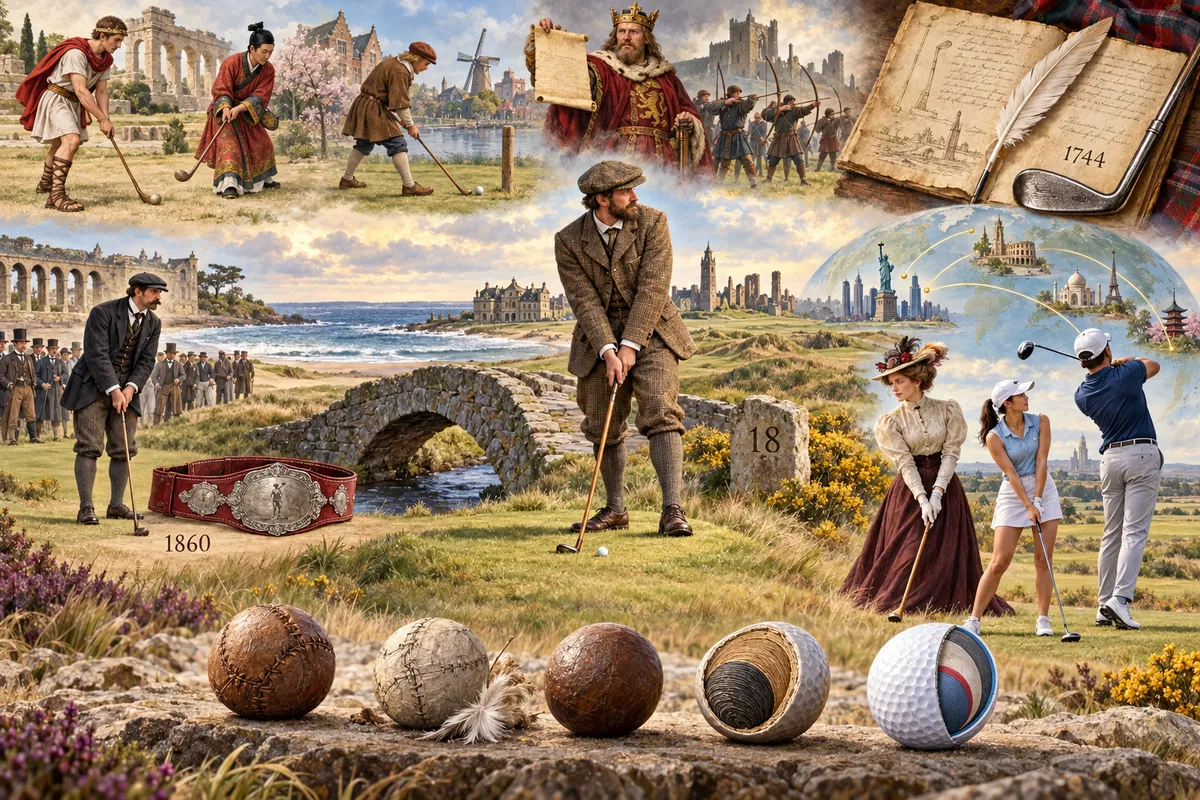
An illustrated journey through golf’s history: early games, Scottish traditions, rules, championships, equipment and the global game.
Before Scotland
Several older games had something in common with golf. The Romans played paganica with a bent stick and a stuffed ball. In China, chuiwan was played from roughly the 8th to the 14th century. England had cambuca and France had chambot.
The strongest claim comes from the Low Countries. The Dutch game of colf (or kolf) is mentioned in a manuscript from 1261, a golf-like game is recorded at Loenen aan de Vecht in 1297, and Brussels banned colf in its streets in 1360. Some historians think Flemish and Dutch traders brought the game to Scotland. What the Scots added, it is commonly argued, was the hole: rather than hitting at a target such as a door or post, the aim became getting the ball into a hole in as few strokes as possible.
The game the king banned
The first written record of golf in Scotland is a ban. In 1457 the Scottish Parliament under James II ordered that “fute-ball and golfe” be stopped, because men were playing instead of practising archery for the defence of the realm.
The ban did not last. James IV lifted it in 1502 and took up the game himself: royal accounts from 1503–04 record money spent on his clubs. Later, Mary, Queen of Scots was accused by her enemies of playing golf at Seton Palace only days after the murder of her husband, Lord Darnley, in 1567.
St Andrews and the 18-hole round
Golf was played on the links at St Andrews through the 1400s, and in 1552 a charter from Archbishop Hamilton confirmed the townspeople’s right to play there.
For a long time a round had no fixed length. The Old Course at St Andrews once had 22 holes. On 4 October 1764 the Society of St Andrews Golfers decided its first four holes were too short and combined them into two. Because the same greens were used going out and coming back, that removed four holes in all and left 18. Other courses followed St Andrews, and 18 holes became the standard worldwide.
St Andrews is not, however, the oldest course on record. Guinness World Records recognises Musselburgh Links, near Edinburgh, where play was documented in 1672.
The first rules
The oldest surviving written rules of golf were drawn up in Edinburgh. In March 1744 the Gentlemen Golfers of Leith wrote 13 “Articles and Laws in Playing at Golf” for a competition for a Silver Club presented by the city council. The winner, a surgeon called John Rattray, signed them. The club is now the Honourable Company of Edinburgh Golfers, and the original document is kept by the National Library of Scotland.
Ten years later, in 1754, the Society of St Andrews Golfers was founded. In 1834 King William IV became its patron and it took the name the Royal and Ancient Golf Club. By the late 1800s it had become the authority on the rules across Britain and the Empire, and from 1919 it ran the Open Championship. In 2004 that work passed to a separate organisation, The R&A, which today writes the Rules of Golf with the USGA (see our guide to the rules).
The first Open Championship
The world’s oldest golf championship began on 17 October 1860 at Prestwick, on Scotland’s west coast. Eight professionals played three rounds of the 12-hole course for a Challenge Belt. Willie Park Sr won with 174, two strokes ahead of Old Tom Morris. Amateurs were allowed to enter from 1861, which is why it became known as the Open.
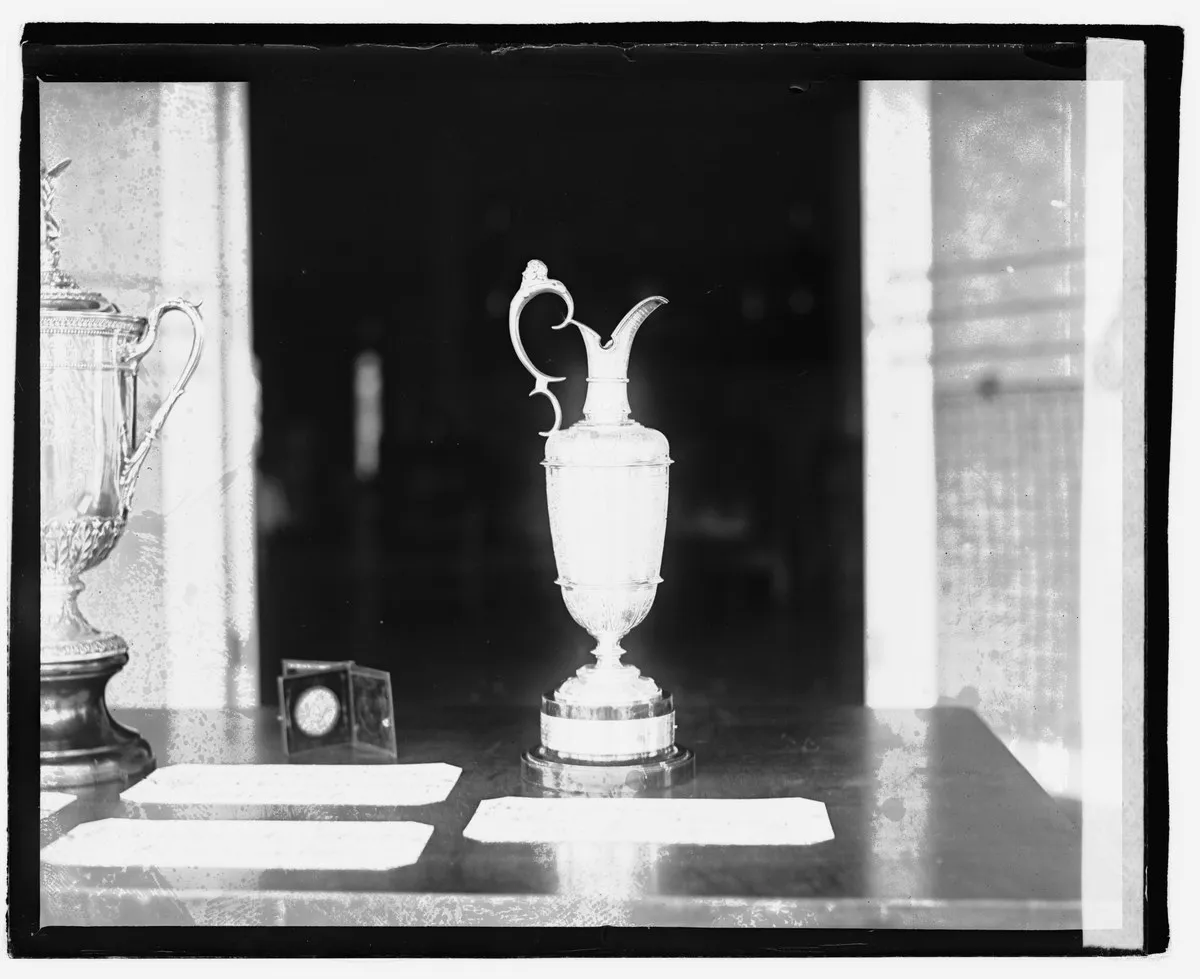
The Claret Jug succeeded the original Challenge Belt and was first presented in 1873. Photo: National Photo Company, 1921 / Library of Congress; no known restrictions on publication.
The ball that changed the game
Equipment has shaped golf’s history as much as any rule.
- Early balls were leather filled with cow hair, imported from the Netherlands from at least 1486.
- The featherie, used from the 1600s, was a leather case packed with wet feathers that expanded as they dried. It flew well but was made by hand and was expensive.
- The gutta-percha ball, or “guttie”, appeared in 1848. Made from the dried sap of a tropical tree, it was cheap and could be moulded in quantity, and it opened the game to far more people.
- The rubber-cored ball was developed in the United States by Coburn Haskell around 1898–1901. Wound rubber thread around a core made it fly further, and after Walter Travis won the 1901 US Amateur with one, the guttie quickly disappeared.
- Modern balls use solid cores and several layers. Since 2000, multi-layer balls with urethane covers have replaced the old wound balls at the top level. The rules limit the ball to a diameter of at least 1.68 inches (42.67 mm) and a weight of no more than 1.62 ounces (45.93 g).
Concern about how far the ball now travels has led to a change in how balls are tested. From January 2028 new ball designs used in elite competition must pass a tougher distance test, and recreational golfers will follow from January 2030. The R&A and USGA estimate most club golfers will lose five yards or less.
Golf spreads around the world
From Scotland the game moved south and overseas. Royal Blackheath, near London, has records of golf from 1766. The British Empire took golf with it: Royal Calcutta, founded in 1829, is the oldest club outside Britain, and Royal Montreal (1873) is the oldest club in continuous existence in North America. Japan’s first club opened at Kobe in 1903.
In the United States, John Reid and his friends founded St Andrew’s Golf Club in Yonkers, New York, in 1888. In December 1894 five clubs formed what became the United States Golf Association (USGA), and by 1932 more than 1,100 clubs belonged to it.
Women’s golf
Women have played golf for centuries, but the first recorded women’s competition was held at Musselburgh in 1811, for local fishwives. In 1867 the St Andrews Ladies’ Golf Club became the first golf club for women; its members played on the putting course now known as the Himalayas. The Ladies’ Golf Union was founded in 1893 and merged with The R&A in 2017. In the United States, 13 women, including Patty Berg and Babe Zaharias, founded the LPGA in 1950, which is still the world’s leading women’s professional tour.
Today there are golf courses in more than 200 countries, from the old Scottish links to new courses across Asia and Eastern Europe. You can read how big the game has become in golf around the world, or meet the players who made its history in famous golfers.