About golf
Everything you need to understand the game, from its Scottish origins and the Rules of Golf to handicaps, the Olympics and the players who shaped it.
How golf works
The aim is simple: use a golf club to hit a small ball into a hole in the ground in as few shots as you can. A club is the long-handled piece of equipment you swing to hit the ball. You carry different clubs for long shots, short shots and rolling the ball.
Meet the clubs: what's in a golf bag?
A golf course is a series of holes. “Hole” means both the small cup the ball goes into and the whole stretch of ground leading to it. Each one has a starting area and a finishing area, often with grass, sand or water in between.
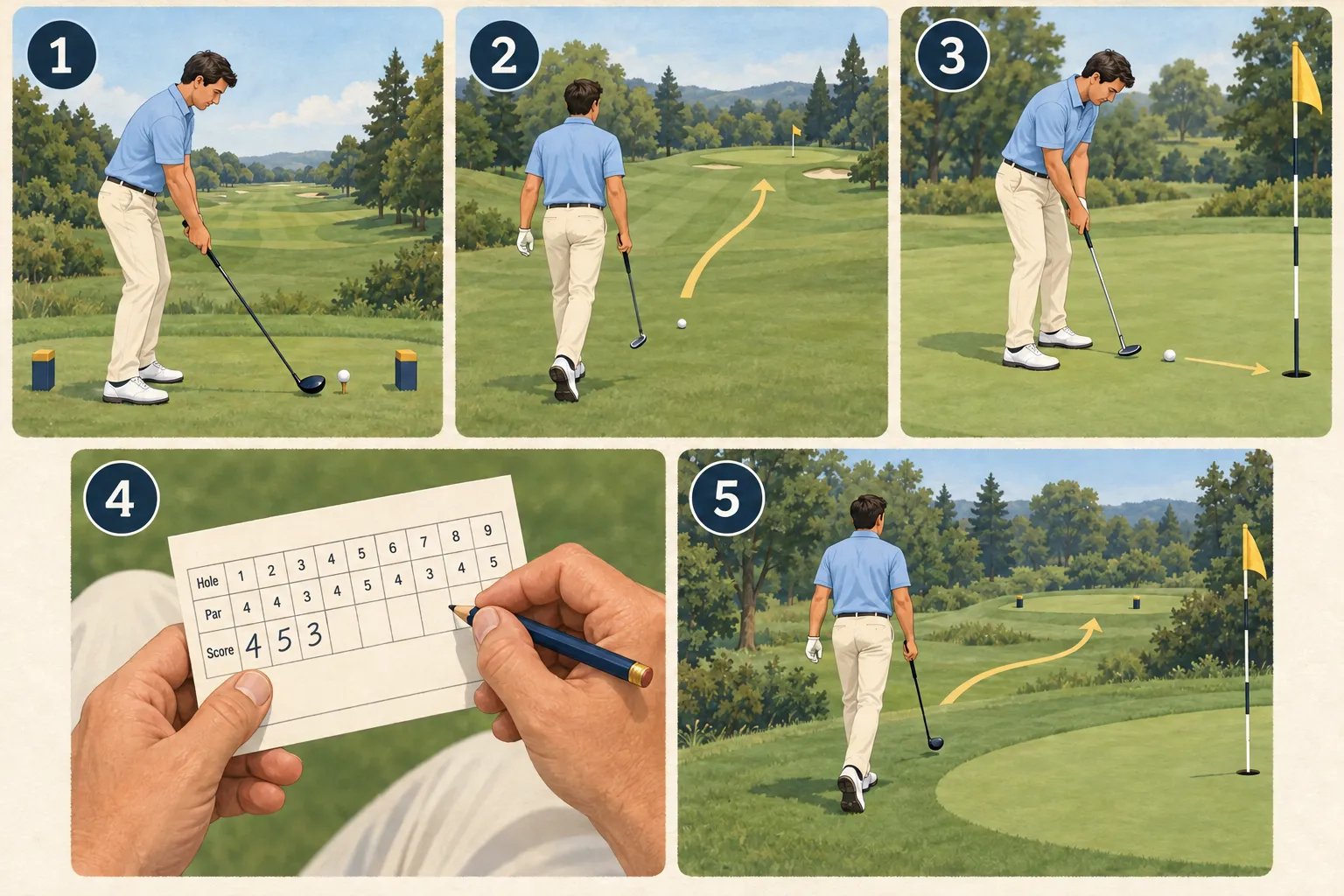
Start at the tee
Hit your first shot from the marked starting area, called the teeing area. You can rest the ball on a small peg, also called a tee, for this shot.
Move towards the hole
Walk to your ball and hit it again from where it has stopped. Aim for the fairway, the strip of shorter grass that usually leads towards the hole. A hole often takes several shots.
Roll it into the cup
Near the finish is the green, an area of very short grass with a cup marked by a flagstick. Use a club called a putter to roll the ball into the cup.
Count your shots
Each attempt to hit the ball counts as a stroke. Include the little putts as well as the long shots. Some rule infringements add penalty strokes to your score.
Go to the next hole
Write down your score and move to the next starting area. Playing the holes in order makes a round, commonly nine or 18 holes. You can start by learning on just a few.
What does the score mean?
Par is the number of strokes an expert golfer is expected to take on a hole. On a par 4, four strokes is par, five is one over par and three is one under par. Beginners usually take more shots, and that is normal.
For example: one long shot, a second shot onto the green and two putts make four strokes. On a par 4, you have made par.
You can play for enjoyment, try to improve your own score or compete with others. In ordinary stroke play, you add up the scores for all the holes, and the lowest total wins. Other formats score differently, and a handicap can help players of different abilities compete fairly.
Players usually go around in small groups, with each person playing their own ball. Wait until others are safely out of the way before hitting. For your first visit, a lesson at a practice area is a good way to learn how to hold a club and hit the ball before going onto the course.
Next, explore the guides below or find somewhere to play and take a lesson in Moldova.
What's in a golf bag?
Meet the driver, woods, hybrids, irons, wedges and putter: how to recognise them, what each does, and a simple beginner's bag.
A short history of golf
How a game banned by a Scottish king became a global sport: the first rules, the 18-hole round, the Open Championship and the ball that changed everything.
The Rules of Golf, explained simply
Who writes the Rules of Golf, what changed in 2019 and 2023, and the key rules every golfer should know, from lost balls and penalty areas to the putting green.
Golf around the world
How many people play golf, where the world's courses are, who runs the game, and the professional tours, majors and team events that make up the global calendar.
Golf at the Olympic Games
Golf was played at the 1900 and 1904 Olympics, then disappeared for 112 years. How it returned, how players qualify, every modern medallist and what is new for Los Angeles 2028.
Famous golfers: the greats and today's stars
The players who shaped golf, from Old Tom Morris and Bobby Jones to Nicklaus, Woods and Sörenstam, plus today's stars and players linked to our region.
Golf handicaps and the World Handicap System
How a golf handicap lets players of any ability compete fairly: Handicap Index, Course and Slope Rating, how your handicap is calculated and how to get one.
Golf lessons in Moldova
Where you can take golf lessons in Moldova, who teaches them, what to ask before you book, and what happens in your first lesson.